Government to provide facilities to transform Sri Lanka Police into highly respected service, President says
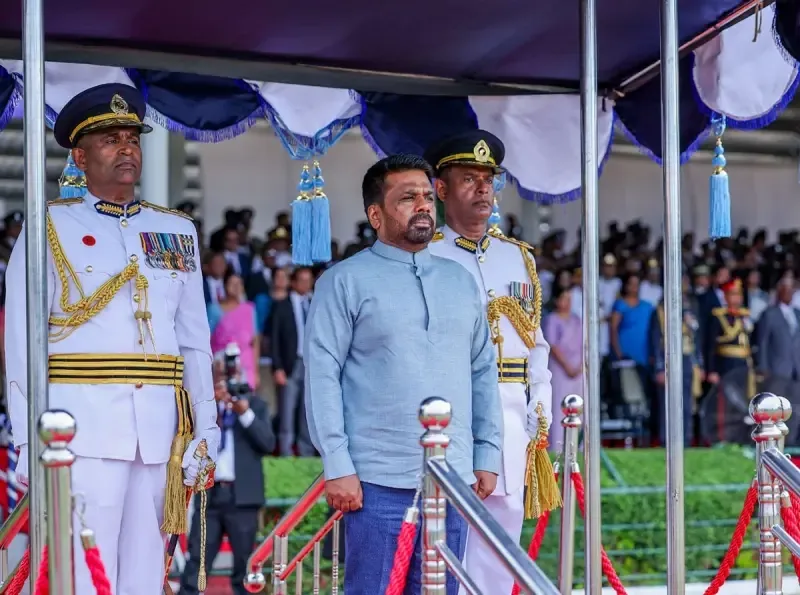
President Anura Kumara Dissanayake said steps would be taken to provide the necessary facilities to transform the Sri Lanka Police into a highly respected service. He made the remarks while participating in the 160th Police Day commemoration at the Thimbirigasyaya Field Force Headquarters this afternoon (03).
He said a proper promotion scheme would be introduced, a new uniform is expected to be provided by around the middle of next year, and measures would be taken to provide all police officers with a risk allowance, develop the necessary infrastructure and recruit the required human resources.
The President was accorded a ceremonial police welcome on arrival.
Reflecting on the 160-year history of the Sri Lanka Police, he commended the vital role it had played in serving the public and maintaining public peace and security during periods of conflict, natural disasters, epidemics and other crises. He said an institution completing 160 years represented a long and significant history, and that throughout this period the Sri Lanka Police had played a demanding and commendable role whenever the people faced such crises. As a result of that service, he said, citizens continued to hold the Police in a position of respect, appreciation and trust. He also acknowledged that criticism and allegations concerning the Police existed.
He emphasised that the primary responsibility of the Police today was to strengthen public trust while addressing and overcoming the criticisms and allegations directed at the institution. Despite any criticism, he noted, people continued to request police stations and police services in their areas, demonstrating the importance of the Police in maintaining public peace and security. He acknowledged that many senior police officers throughout the institution's 160-year history had earned respect and trust through their leadership and service, but that the actions of certain officers had contributed to criticism and diminished public confidence. He emphasised that the responsibility of every officer serving in the Sri Lanka Police today was to protect and strengthen the dignity and public trust associated with the profession.
The President observed that the priorities of the Police had evolved over the past 160 years. Given the serious challenges currently confronting society, he identified combating the illicit drug menace and organised criminal gangs associated with it as the foremost national responsibility of the Police. While this responsibility had been formally entrusted to the Police as part of their duties, he called upon all police officers to regard it not merely as a professional duty, but as a broader social responsibility, and to dedicate themselves to protecting society from the devastating effects of illicit drugs and organised crime.
He also warned against police officers becoming involved with drug traffickers or being compromised by organised criminal networks. He called upon officers who had been intimidated or influenced by such networks to reject fear and remain committed to their responsibilities and integrity. He stressed that officers who failed to uphold these standards should not remain in uniform and expressed confidence that disciplinary authorities would take appropriate action based on proper investigations, inquiries and evidence. He stated that the reputation of the Sri Lanka Police as a respected institution should not be undermined by the actions of a small number of individuals.
The President commended the Sri Lanka Police for conducting the highest number of drug raids and arrests in the country over the past two years. He stated that 5,255 kilograms of heroin, 9,966 kilograms of "ice", 44,684 kilograms of Kerala cannabis and 16.2 million tablets and capsules had been seized. He noted that these operations had helped prevent a large number of young people and schoolchildren from falling victim to the devastating effects of illicit drugs and expressed his appreciation for the contribution made by police officers.
He also commended the Police for bringing 74 armed criminals who had been hiding overseas back to Sri Lanka with the assistance of international authorities. He noted that they had been brought back with the assistance of various intelligence units of the Police Department and the cooperation of foreign governments. He said efforts were underway to bring several more such suspects back to the country in the near future. He further noted that a large number of sophisticated firearms had been seized in these operations and commended the Police for their contribution towards combating organised crime.
The President acknowledged that police officers conduct investigations at considerable personal risk. He pointed out that by the time investigations are completed, reports are submitted to the Attorney General's Department and judicial proceedings are concluded, investigating officers often reach retirement age. He therefore stressed the need to expedite not only investigations but also the judicial process, so that offenders are brought to justice without undue delay. He also acknowledged that the public has concerns about what happens to seized drugs and suspects following arrests, noting that people expect offenders to receive appropriate punishment through the courts after proper cases are filed.
He emphasised that delays in the judicial process must be addressed and that all institutions involved in the administration of justice must be strengthened. Failure to impose appropriate punishment for crime within a reasonable period, he noted, could encourage further criminal activity. He said the Government had decided to make all relevant processes more efficient and would provide the necessary legislation and infrastructure to achieve this objective. He reiterated that if constitutional amendments were required to protect the public, the country and the younger generation, the Government would not hesitate to introduce them. He emphasised that the Government would take every necessary measure to provide the legislation and infrastructure required to transform Sri Lanka from a state affected by crime into a peaceful nation, and assured the Police that the Government was committed to that transformation.
Addressing the shortage of police personnel, the President stated that approval had already been granted to recruit 10,000 new officers to the Sri Lanka Police. He acknowledged that police officers perform highly demanding duties and said that, in addition to the third salary increment for public servants scheduled for January next year, he expected to provide a risk allowance to all police officers.
He also acknowledged concerns among police officers regarding career progression. Recalling a statement he had made in Parliament while serving as an Opposition MP, that some officers could join the Police as constables, remain constables throughout their careers and retire as constables, he said that as President it was now his responsibility to establish a proper promotion system that would recognise and motivate the Police workforce. He said that, in addition to promotions based on seniority, opportunities should be provided for promotions based on merit and examinations. Measures would therefore be taken to address the backlog of promotions in consultation with the Public Service Commission and to ensure that officers who have been awaiting promotions are appropriately accommodated until their promotions are granted.
The President emphasised that the Sri Lanka Police requires both adequate human resources and modern infrastructure. He said the Government has decided to purchase nearly 700 motorcycles and 200 single-cabs for police duties. In addition, 138 cabs have already been received under Indian assistance. He announced that funds would be allocated in the forthcoming Budget to construct a modern Police Headquarters. He also noted that the Criminal Investigation Department (CID) is currently housed in an old building and said that provisions would be made in the forthcoming Budget for a suitable new building for the Department. He further stated that the Government expects to allocate funds in the forthcoming Budget to modernise the Police Hospital and provide accommodation facilities, relocate police stations currently operating in rented buildings to Government-owned premises and construct official housing for police officers.
He said the Government would therefore develop the human resources and infrastructure required by the Sri Lanka Police while integrating modern technology into its operations. He also noted that several important applications developed jointly by the Sri Lanka Police and a private-sector company had been launched at the event. He stressed the importance of providing police officers with the knowledge and training required for investigations and said that funds would be allocated through the Budget for training programmes. He further announced that a new uniform is expected to be introduced for the Sri Lanka Police by around the middle of next year.
As part of efforts to improve the efficiency and speed of public services and formalise information exchange between the Police and the public, the Sri Lanka Police Mobile App was launched and the newly upgraded www.police.lk website was officially unveiled. A commemorative stamp and first-day cover issued to mark the 160th anniversary of the Sri Lanka Police were also presented to the President.
Symbolising the promotion of 1,489 police officers below the rank of Chief Inspector and 153 officers of the Police Special Task Force under the long-service scheme, with effect from 1 January 2026, promotion letters were formally presented by the President.
In recognition of the President's participation in the 160th Police Day commemoration, Inspector General of Police Attorney-at-Law Priyantha Weerasuriya presented a commemorative gift to the President.
The President emphasised the need to create a police service suited to the modern era and transform the Sri Lanka Police into a highly respected public service. Acknowledging that police officers interact with the public on a daily basis, often under challenging circumstances, he said the Government was committed to creating an environment that supports their mental well-being and enables them to provide a more friendly and professional service. He expressed his determination to build a new Sri Lanka Police that would enable the public to establish a closer and more constructive relationship with the institution.
Minister of Public Security and Parliamentary Affairs Ananda Wijepala, Deputy Minister of Public Security and Parliamentary Affairs Sunil Watagala, Deputy Minister of Defence, Major General Aruna Jayasekara (Retired), Governor of the Western Province Hanif Yusoof, Secretary to the President Dr Nandika Sanath Kumanayake, Secretary to the Ministry of Public Security and Parliamentary Affairs Ravi Seneviratne, High Commissioners and Ambassadors, Commanders of the Tri-Forces, Senior Deputy Inspector General of Police (Administration) Sanjeewa Dharmaratne and other Senior Deputy Inspectors General of Police and members of the Sri Lanka Police were present at the event.
Comments (0)
- No comments yet - be the first.